

We like to think that we would be heroes, the kind of people who would save others or stand up for our principles. History and literature are full of examples of folks who become heroes when the opportunity arose. For my part, I’ve always had a soft spot for people who make different decisions because I think these stories are more honest, even if they’re more ignoble. I know enough about myself to realize that I’m no hero. If given the choice between dying to save someone else and living, I’ll probably choose to live. So when I met Rebecca West, the protagonist of A.K. Blakemore’s outstanding novel The Manningtree Witches, I knew I’d found a kindred spirit in this regard.
The Manningtree Witches is based on historical events that took place during the English Civil War. It even features real people like the notorious Witchfinder General Matthew Hopkins. Rebecca West and her mother also appear in the historical record. We meet the prickly and peculiar Rebecca on an ordinary day in the town of Manningtree, Essex in 1643. It’s an ordinary day for her. She gets up, grabs a bit, bickers with her mother, and goes to work. She lives a hard life near the bottom of the social pecking order. Shortly after this introduction, Matthew Hopkins arrives and purchases one of the town’s taverns. His quiet but menacing presence makes his real business—seeking out witches—readily apparent. It’s not long before cold, hunger, and misfortune start to bring out the worst in people. Egged on by Hopkins’s talk of witches and demons, folk start to point fingers at Rebecca’s mother and her friends. Rebecca gets swept along with them because it is a lot easier to tar someone with the brush of witchcraft than it is to exonerate them.
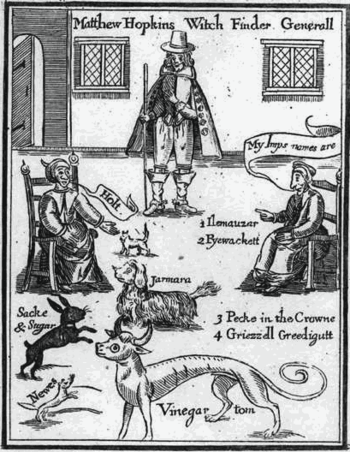
We follow Rebecca as tensions rise in Manningtree. Through her eyes, we see the mundane spats between West’s mother and the other accused witches that later become the evidence used to convict these women. A sharp word to an annoying child is transformed by the townspeople into a witch’s curse. A fatal illness or a miscarriage are seen as proof that there are agents of the devil walking around. Rebecca is much more rational than Hopkins and the rest of the accusers. She knows that there are reasonable explanations for everything. But, because she is so shy and of such low status, no one listens to her when she manages to get a word out.
Rebecca’s inability to speak up for herself also provides ample room for her to think about the catch-22 she’s in. When Hopkins gives Rebecca a way out—if she lies about her co-accused and confesses to being caught up in witchcraft—she’s faced with a stark choice. On the one hand, is there any honor in telling the truth and being hanged as a witch? On the other, could she live with herself for lying and condemning her mother and her mother’s friends? Rebecca grew up in a Puritan town. Lying is a sin, let alone betraying her mother. But then, committing the sin of a lie might be a small price to pay for one’s life and the chance to get far, far away from Manningtree.
The Manningtree Witches is written in lively and authentically old-fashioned language that made me feel like I was sitting on Rebecca’s shoulder while she worked and pondered and debated. I relished the vocabulary of this book and utterly adored the vivid descriptions of the poor, backward town of Manningtree. The fantastic writing, paired with the rich character development of Rebecca and Hopkins, made this a knockout work of historical fiction. It’s one of the best I’ve ever read about a witch trial. It’s never sentimental but honest and gritty.
Sounds like it would be a great, but tough read. Might make me look at myself a little too closely. 🙂