
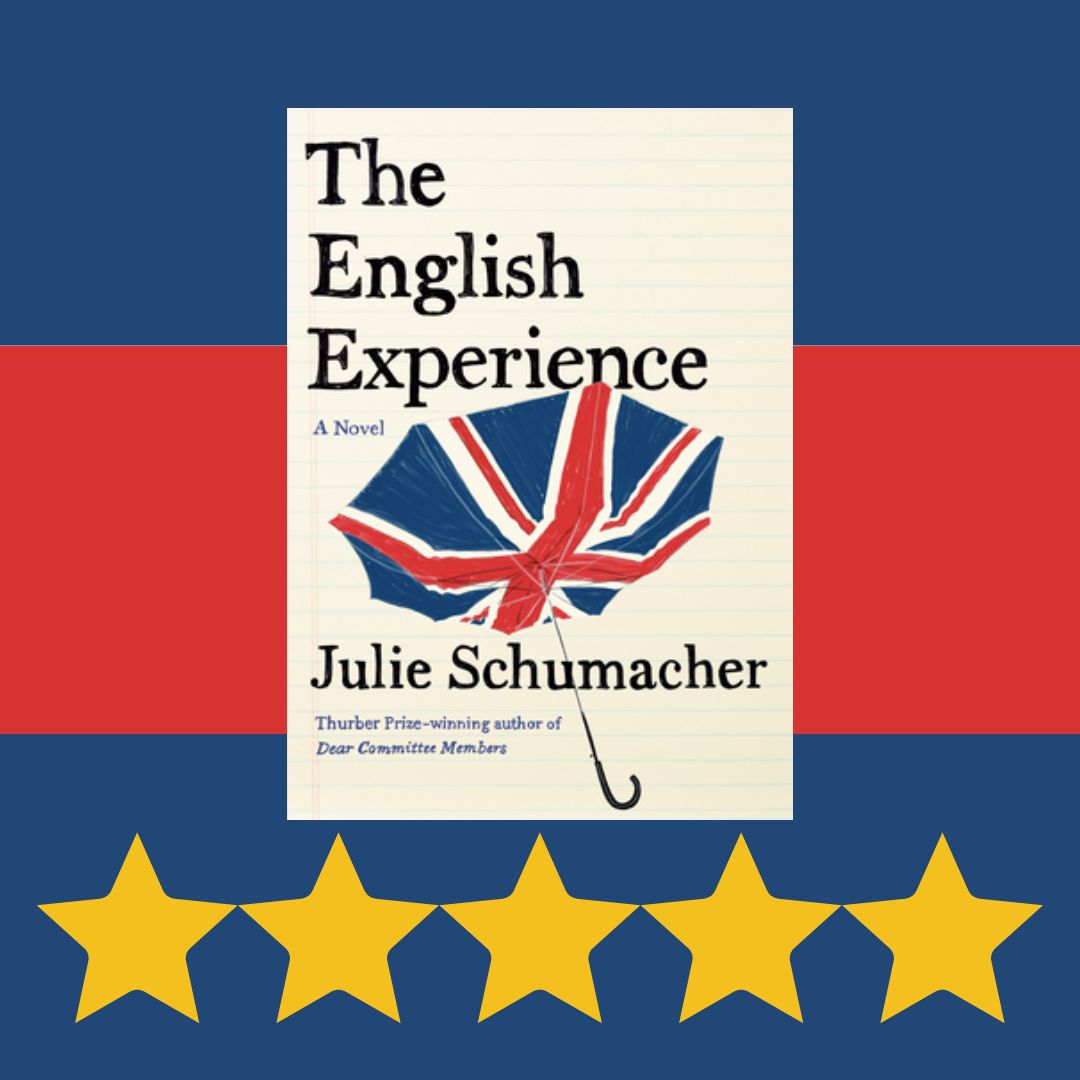

Once more, Jay Fitger has his arm twisted by the sadistic administration of Payne University. This time, they want him to accompany a cohort of students to London, England, on a study abroad experience. On short notice. Or else. As always, Fitger complains and carps and pleads that he’s got tons of grading to do. And, as always, the admins run roughshod over him with threats about funding for the English department. Before he knows quite what’s happening, Fitger is on a plane with a bunch of fractious undergraduates in Julie Schumacher’s hilarious satire, The English Experience.
To help us understand what Fitger has to deal with as he shepherds his students through museums and galleries and historical sites, Schumacher includes the students’ applications and excerpts from their assignments—misspellings, malapropisms, and all. It makes for entertaining reading. It also means that we get extra stories along with Fitger’s follies. (Fitger manages to injure himself falling down the hostel stairs on his first night in England.) We learn that two students are going through a rough breakup; one wants to win back the affection of the other. Other students are homesick; one of these has to keep taking off to text her mom back. One student thought he was signing up for study abroad in the Cayman Islands. None of them seem to know what they’re really in for. The plane hasn’t even taken off before they’re all complaining about the workload.
Fitger spends a lot of the book grumbling about his lot. This is par for the course if you’ve read the first two books in this series. But if you pay attention to what’s going on in the students’ assignments or to the dialog between Fitger and his students, you’ll see evidence that Fitger is actually quite a good teacher in spite of himself. One of the lovelorn students starts to admire writing and actually improve. Another student makes even more progress to overcome his grief at losing a good friend in high school. Yet another begins to relate to his peers rather than burying everyone in weird trivia or gothic stories. Some pearls of wisdom—and tips for developing a thesis and organizing an argument—are clearly getting through.
The English Experience might be the last book in the series. The resolution leads me to think that it is, and so I feel a bit sad to say goodbye to the best satire of academia I’ve ever read. I heartily recommend this book and the rest of the series to any readers who have been exposed to American higher education. I’d recommend this even to readers who haven’t but are looking for a good laugh at dysfunctional organizations and the prickly people who somehow keep them running.
I received a free copy of this book from the publisher via NetGalley, for review consideration.