
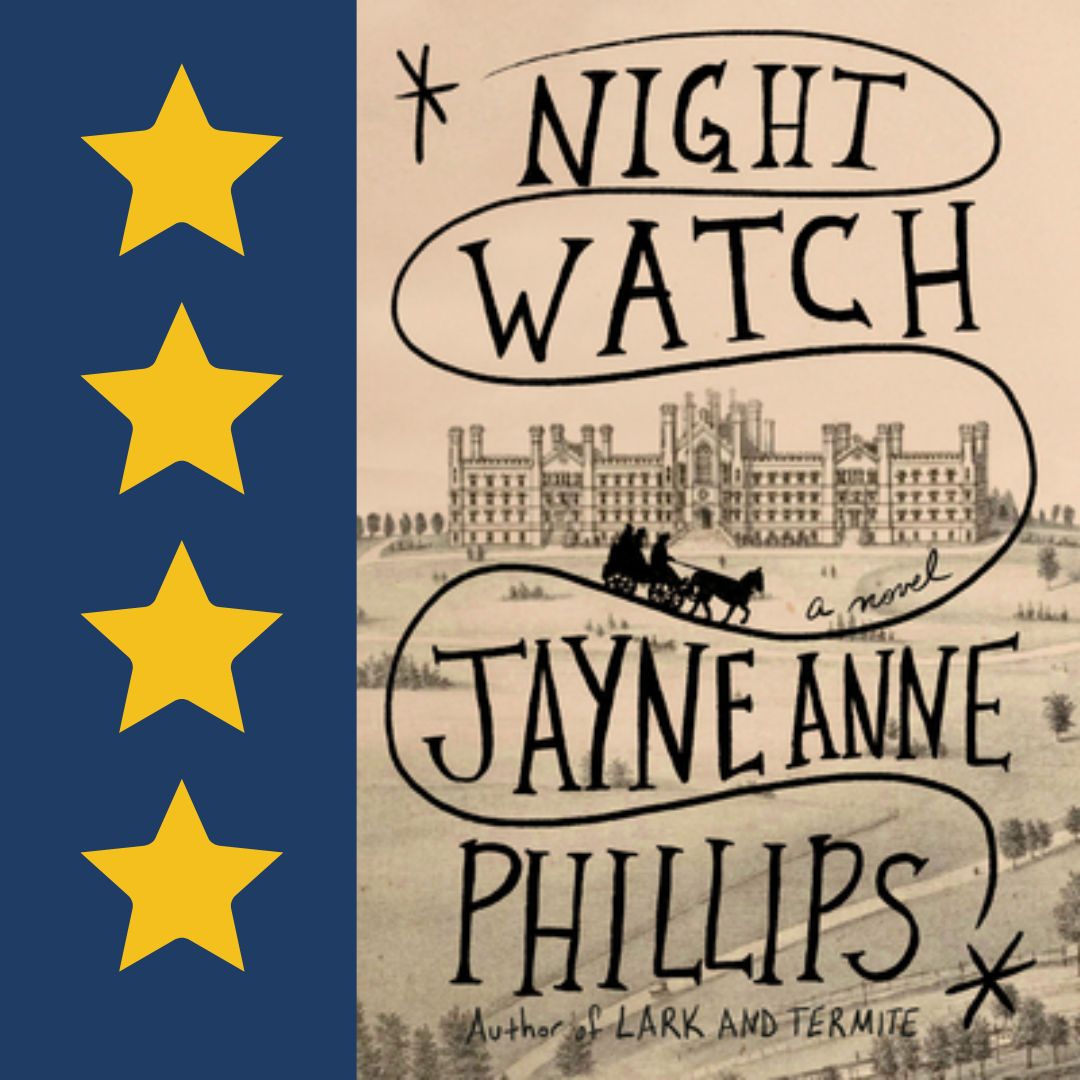
Trigger warnings for rape and coercion.

There are a lot of secrets in Jayne Anne Phillips’s haunting novel, Night Watch. They slowly unspool over the course of 300 pages in a way that made me feel like I almost couldn’t bear to hear another, while at the same time drawing me along until every bit of plot had been wrung out of the characters. But then, set against the turmoil and trauma of the American Civil War, I suppose it’s not surprising to see what the small family at the heart of this novel has to bear.
Like many novels about concealed, Night Watch is told in a nonlinear fashion and from the perspective of characters who observe much but say little. Our primary narrator is ConaLee, a young girl who had to grow up fast as her mother sank into a deep depression. ConaLee is, on the one hand, extremely capable and, on the other, the kind of character who I wanted to see given a chance to be a carefree child. Our other narrator is ConaLee’s grandmother—at least ConaLee thinks Dearbhla is her grandmother. ConaLee is our eyes and ears in the novel’s present, in the early 1870s, when she and her mother appear at the Trans-Allegheny Lunatic Asylum in Weston, West Virginia. Dearbhla fills us in on what happened to ConaLee’s parents before and during the war. Other voices join ConaLee and Dearbhla’s occasionally to share secrets the two aren’t privy to.
Through the eyes of these very competent yet vulnerable women, we see tragedy and violence and the tightness of family bonds. There are points in Night Watch that reminded me of Charles Frazier’s Cold Mountain, especially when a Southern deserter arrives to inflict terrible violence on ConaLee’s mother. There are several passages that are hard to read; thankfully, they’re brief. Their inclusion—along with one character’s harrowing narration of the Battle of the Wilderness and an amnesiac’s description of a long convalescence after that same battle—serves as a powerful less of how careless people can be with the bodies and souls of persons they consider property or cannon fodder.
Lest my description make it sound like Night Watch is nothing but misery, I want to add that the conclusion to the novel contains redemption in the form of characters regaining agency over their bodies. Characters claim their freedom by finding new names and new paths or through the reclamation of their memories or through the permanent removal of their tormenters. There isn’t a happily ever for everyone in this book but there’s plenty of narrative satisfaction to go around.
Readers who enjoy stories of the Civil War that focus on the collateral damage of the fighting rather than the military history will like Night Watch, I think, as will readers who are curious about the wide experience of mental illness in the nineteenth century. If nothing else, I’d say pick Night Watch up for its stunning characters.
I received a free copy of this book from the publisher via NetGalley, for review consideration.
