
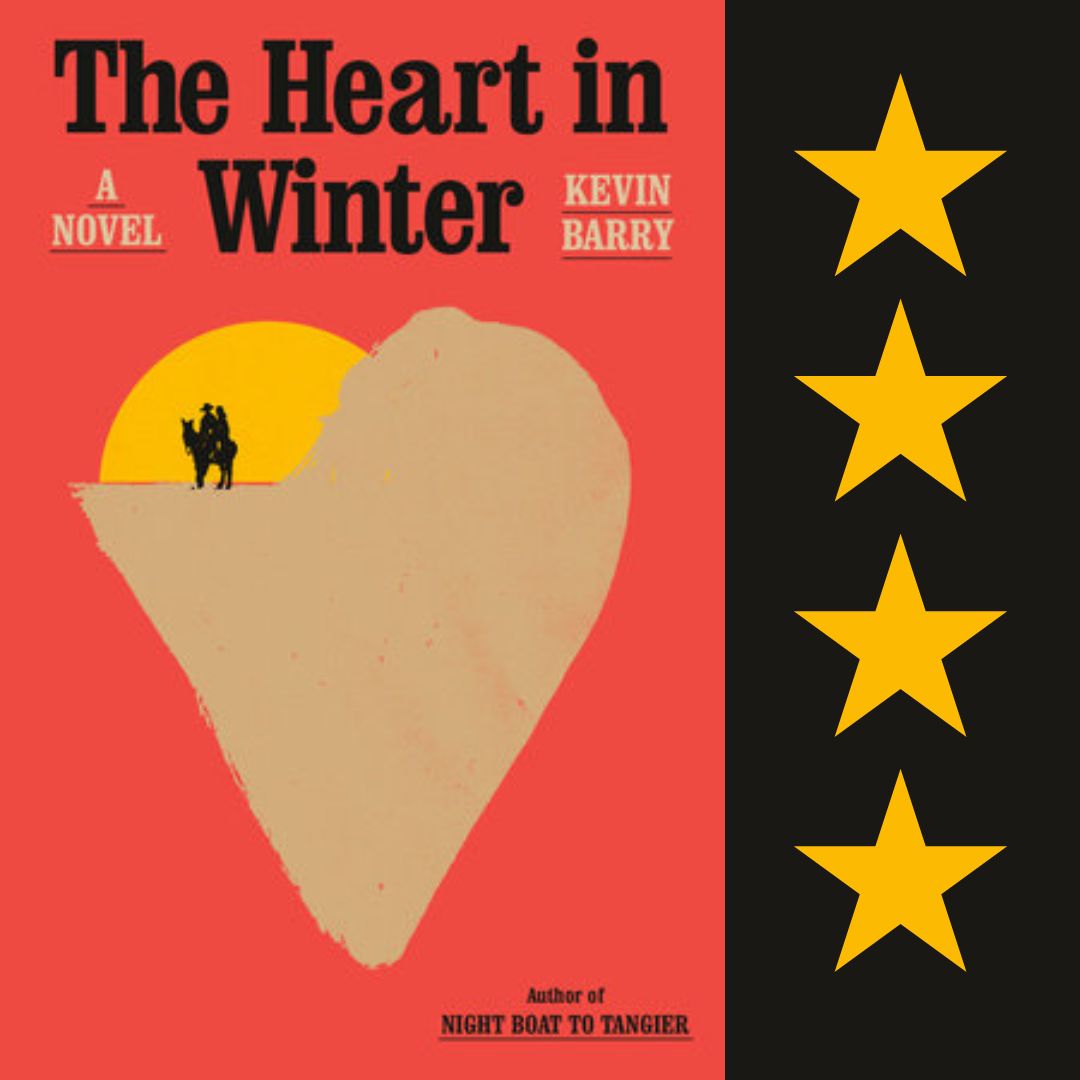

Late in Kevin Barry’s amazing novel, The Heart in Winter, rumors start to race around Montana and Idaho as people recount what they heard about Tom Rourke and Polly Gillespie’s doomed love. It sounds like a tall tale or sordid scandal or a blues song the way folks tell it. They’re not far wrong. There are elements to Tom and Polly’s story that, if we hadn’t just read them, would be dismissed as tropes from an old Western.
Tom Rourke is a man not long for this world. He trudges the dirty streets of Butte, Montana, looking for drink or drugs and avoiding people he owes money. He makes money for his vices with odd jobs and writing letters for illiterate men and selling song lyrics to bars and brothels. While Tom goes on his drunk, we see brief scenes of Tom plying his trade writing letters back east for men who are hunting for a wife. To be fair, there weren’t that many ways to make money in Butte in 1881 if you didn’t want to be a miner.
We’re given to believe that he’s pretty good at talking women into marriage (possibly because these women can’t see what they’re getting into). One of these women, Polly Gillespie, arrives shortly after Tom’s bender. His letters talked her into marrying Long Antony Harrington, a captain at Anaconda Copper. But when Tom spots her at the photographer’s studio where he earns a bit of money, he falls instantly in love. Or lust. Polly also falls, too, and the two begin a passionate affair. The next thing anyone knows, Tom has hatched a plan for the two to run away to San Francisco.
Reading this book was a peculiar experience for me. Much of the book takes place in the Idaho Territory. (Idaho didn’t become a state until 1890.) I lived in Pocatello (the couple’s first destination) for about fifteen years and Barry references several places I think only Idaho people know of: Driggs, St. Anthony, the Portneuf (formerly Pontneuf) and Snake Rivers, Pocatello itself. It didn’t take much of Barry’s beautiful and idiosyncratic language to bring the Idaho wilderness to life for me. (Thankfully, there are far fewer outlaws in the woods these days.)
Barry’s writing does take some easing into. I had to slow myself down more than once to get the rhythm of Tom’s internal monologue. Once I had a feel for Tom’s turn of phrase, I fell in love with the narrative’s use of language and vibrant vocabulary. The plot is utterly gripping and the characters, like I said above, could’ve walked right out of a song or a dime novel—but in the best possible way. This book is an incredible ride.
