
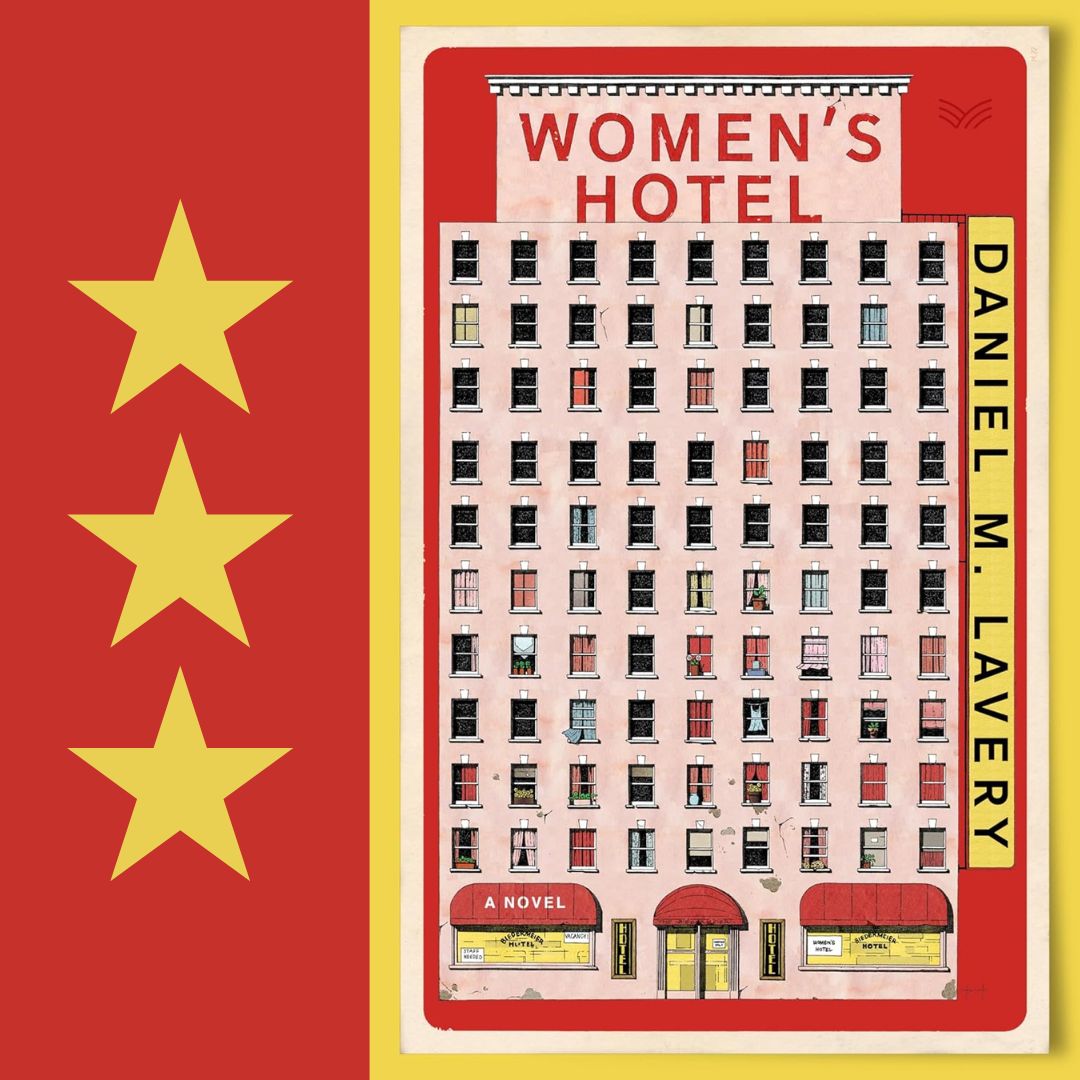

In his author’s note before Women’s Hotel, Daniel M. Lavery discusses his fascination with women’s hotels. Women’s only residential hotels offered women a place to stay while they developed careers or found spouses. Some of these hotels, like the Barbizon, was home to famous writers, models, artists, and executives before they made it big. They offered a safe place at a reasonable price, though men were often barred from the higher floors and some hotels required references for new tenants. Legal and economic changes spelled the end of women-only residential hotels by the 1970s. I can understand how these hotels and their revolving tenants would intrigue a writer.
The Biedermeier, our setting for much of Women’s Hotel, is not the Barbizon. Its tenants include writers and artists and secretaries and one former dancer but the Biedermeier seems to be home to women who are either maintaining their status or are on their way down. These are women who will attend church services or society meetings in order to pilfer the refreshments. Some of the women are elderly singles who lack family to care for them. Others have yet to find better jobs or a well-off husband to whisk them away from the Biedermeier. For all of the hotel’s privations, however, it’s a place that offers a lot of freedom for its tenants and a network that supports them through their troubles.
The narrative drifts from character to character. There’s Lucianne, who can wind men around her finger but prefers to stay single in case a better future comes along. Pauline is one of my favorite Biedermeier residents. She’s a radical from a family of radicals who enjoys living on the margins. There are Kitty and Ruth, who lean too hard on the support of their fellow tenants. Their (for lack of a better word) antics spice things up. Most of the narrative follows Katherine, an alcoholic who found refuge at the Biedermeier. She works as an assistant to Mrs. Mossler, the head housekeeper/manager of the Biedermeier. While Mrs. Mossler worries about how to save costs and find new tenants to fill the hotel, Katherine is the person who resolves conflicts, runs the library, and generally keeps the whole operation spinning.

There isn’t much over-arching plot to Women’s Hotel, though there are many hints that the hotel isn’t going to be able to stay open for much longer without making a lot of changes. Instead, Lavery tells smaller stories about Katherine, Lucianne, and other residents. I was strongly reminded of Vicki Baum’s 1929 classic, Grand Hotel, as I read, though Lavery’s cast of characters is smaller and less Bohemian. The similarity comes from the way Lavery and Baum show us how everyone, no matter how seemingly insignificant, has a unique perspective and a story to tell.
What I liked most about this novel was its writing style. Women’s Hotel feels charmingly old-fashioned to me. (If it weren’t for reference to things like the Paris Peace Accords, I would’ve thought this book was set anywhere between 1930 and 1960. As far as I can tell, Women’s Hotel is set during the mid-1960s.) I loved Lavery’s rich vocabulary and beautifully constructed sentences. The snarky humor used to decribe the various residents and their scrapes had me laughing out loud more than once.
I would strongly recommend Women’s Hotel to readers who enjoy being a fly on the wall, watching the antics of a cast of characters in a place that doesn’t exist anymore.
I received a free copy of this book from the publisher via NetGalley, for review consideration.