
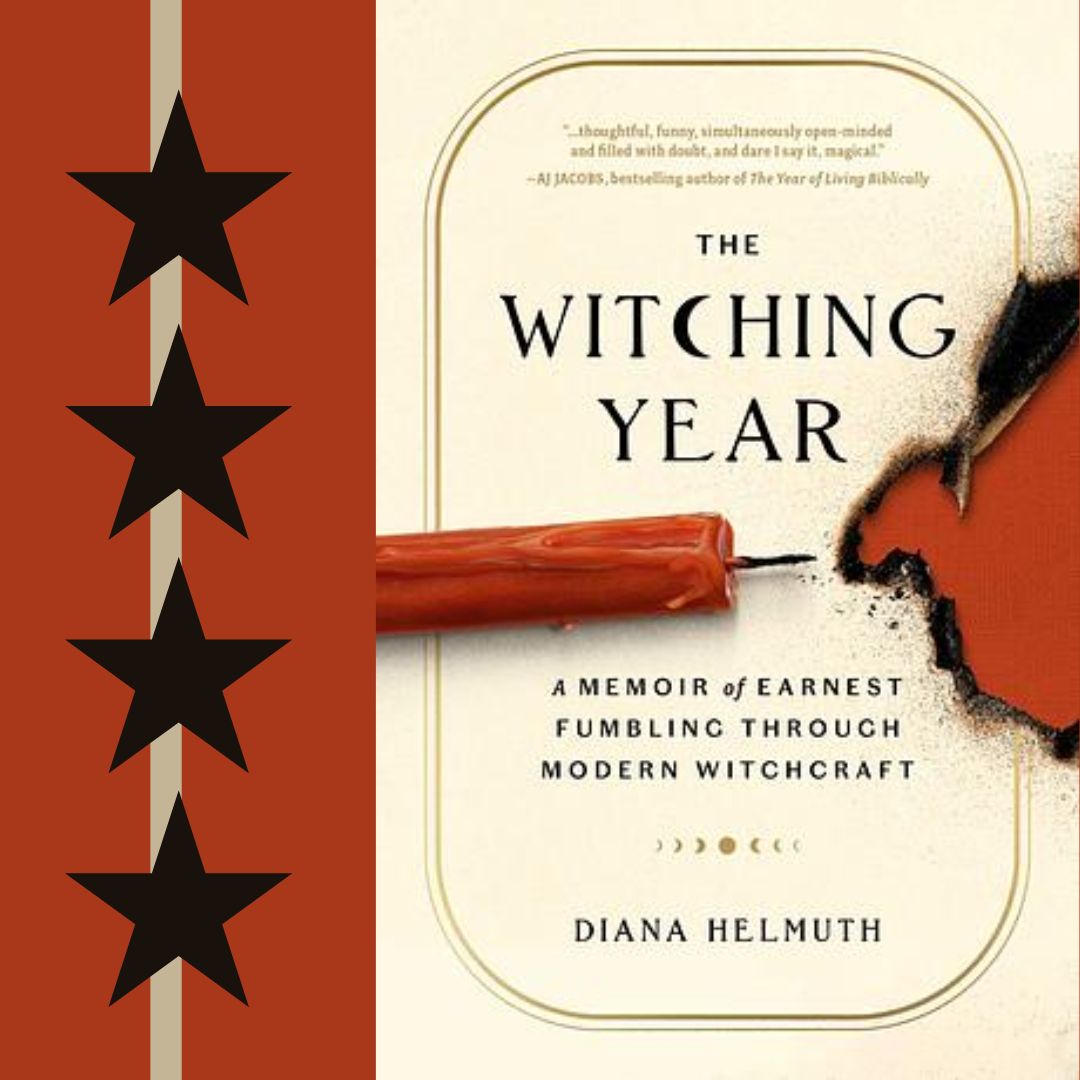

As COVID lockdowns closed the world down, Diana Helmuth began an experiment. For a year and a day, Helmuth would become a Wiccan. She flirted a bit with neopaganism as a teenager (who didn’t?) but never became an adherent. As an adult, Helmuth feels a need to connect to something divine. Also, it would be pretty cool if she could change her circumstances with a bit of witchcraft. The result is The Witching Year, a funny and often moving account of Helmuth’s journey.
Helmuth’s quest starts off rocky. Her arbitrary start date is almost immediately before one of the major Sabbats and not only does she not have any idea what to do, she doesn’t have the right stuff for her altar or any kind of ritual. (She also doesn’t have a place for her altar and ends up using a cardboard box full of old t-shirts and who-knows-what.) Thankfully, there are plenty of places in Oakland, California for her to gear up. She also has friends to help guide her. Her journalism credentials also help her make contact with researchers and established neopagans like Oberon Zell-Ravenheart. Helmuth has so many questions.
Helmuth’s questions fall into two categories, both of which drive her quest. The first set of questions are all about how to be a Wiccan or a witch. Wiccan is a new religious movement. Although progenitors like Gerald Gardner claimed to have found traces of an unbroken pagan faith that survived Christianity, Wicca is very much an invention of the twentieth century. It’s such a decentralized faith that there are a profusion of ways to practice and no one can say what’s correct, or orthodox. Consequently, Helmuth is confronted with contradictory information at every turn. She also has the added complication of weeding out practices that might be cultural appropriation (smudging with white sage, for example, is very common and also very problematic). Does it really matter what color candles you burn? What do you do if you manifest bad luck? What do you do if you can’t feel a connection to a god or goddess? Is it ethical to include her neighbor’s house in an anti-theft protection spell?

The second set of questions are more personal, but much more concise. Is Wicca the right path for Helmuth? She didn’t grow up with a strong tradition of religion. Her mother believes in the healing powers of plants as much as she does in Western medicine. One of her sisters very much believes in ghosts and energies. Wicca isn’t that big a leap for Helmuth, especially not in California. Helmuth attends a weeklong “witch camp” and a Samhain celebration with an assembly of local witches. Most of the time, Helmuth is alone in her office, her garden, or on a trail attempting to make a connection with whatever powers might be out there. There are moments when Helmuth describes transcendent experiences that, depending on how you look at them, might be signs of the supernatural or just indications that Helmuth has successfully entered a trance state. In those moments, Helmuth experiences a lot of catharsis.
I was moved by those moments of catharsis. I’m not attracted to the fussiness of candle colors or ritual chants, but I was joyed by the times when Helmuth was able to use her experiment to wrestle with her grief, feelings of inadequacy, and desire for connection to a higher power. There’s a lot to be said for a faith that can provide a framework for adherents to root out bad mental habits that have held them back or meaningfully interpret their lives or the universe around them. Also, as rational as I believe myself to be, I have to wonder if Helmuth didn’t manage to whip up an effective spell to find the perfect rental in Washington state.