
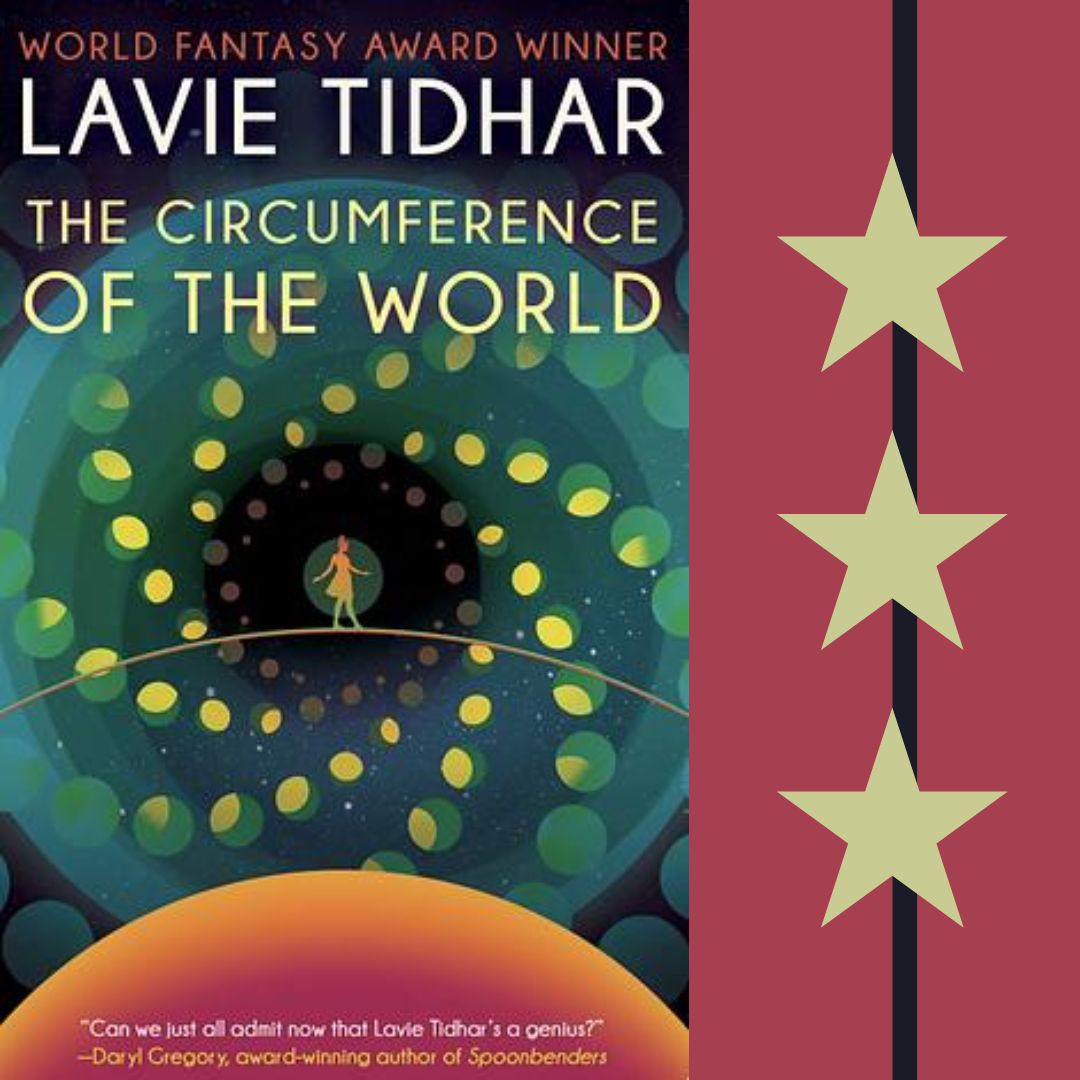

For some people, faith alone is not enough. They have to know. Lavie Tidhar’s deeply layered novel, The Circumference of the World, shows us this obsession over and over through (mostly) the eyes of characters who prefer to live in the here and now rather than push against the boundaries of what can be perceived, measured, and understood by human minds. Even though these characters are content with reality as we know it, they still feel the need to rescue their loved ones from their own madness.
The Circumference of the World revolves around Delia Welegtabit, a Polynesian woman who is a character in this book and also, strangely, a character in a science fiction book by an American writer, Eugene Hartley, who fell off the edge of rationality. The novel is narrated by both versions of Delia, as well as a face-blind bookseller/private detective Delia hires to track down her missing husband. (The face blindness is definitely a liability.) Things get very weird from this point on.
Delia’s hired detective, Daniel, falls into a very strange mystery involving a cult that protects everything about the work of Hartley. They’ve bought up every single copy of Hartley’s The Circumference of the World—to the point that most people don’t believe the book even exists. Anyone asking about Hartley’s book ends up getting a visit from people who punch first and ask questions later. Daniel spends a lot of his time absolutely bewildered by everyone except Delia. Delia not only has a straightforward motivation (she wants her husband back (even though he sounds like a total shit)), her appearance is so unique that Daniel can actually recognize her face.
We never really learn much about what Delia’s husband and the cult are after other than that they want to find out who or what is outside the universe. They believe themselves to be watched by something. The something could be god (in which case, they have a lot of questions.) I was reminded of the Enlightenment theory of god as a divine clockmaker, a god that wound everything up and let it roll. It’s never explicitly stated, but the something could be the author responsible for the stories we’re reading. If the observer is an author, they have completely lost control of their characters. If you take the idea of layers and observation further, we readers are the observers of at least some of the story (and everything we read).
The book ends partway through Hartley’s The Circumference of the World, with Delia making yet another voyage to rescue a man in her life who became obsessed with the idea of finding out what’s outside the known universe. Without a conclusion, we are left to wonder about all the questions Tidhar’s The Circumference of the World raises. There are the plot questions, of course. More importantly, there are questions about the nature of the universe and god and our purpose as sentient beings. After finishing the novel, I’m ready to push back against Socrates’s dictum that the unexamined life is not worth living. From what I saw in the layers of The Circumference of the World, unsolvable questions can drive people insane.