
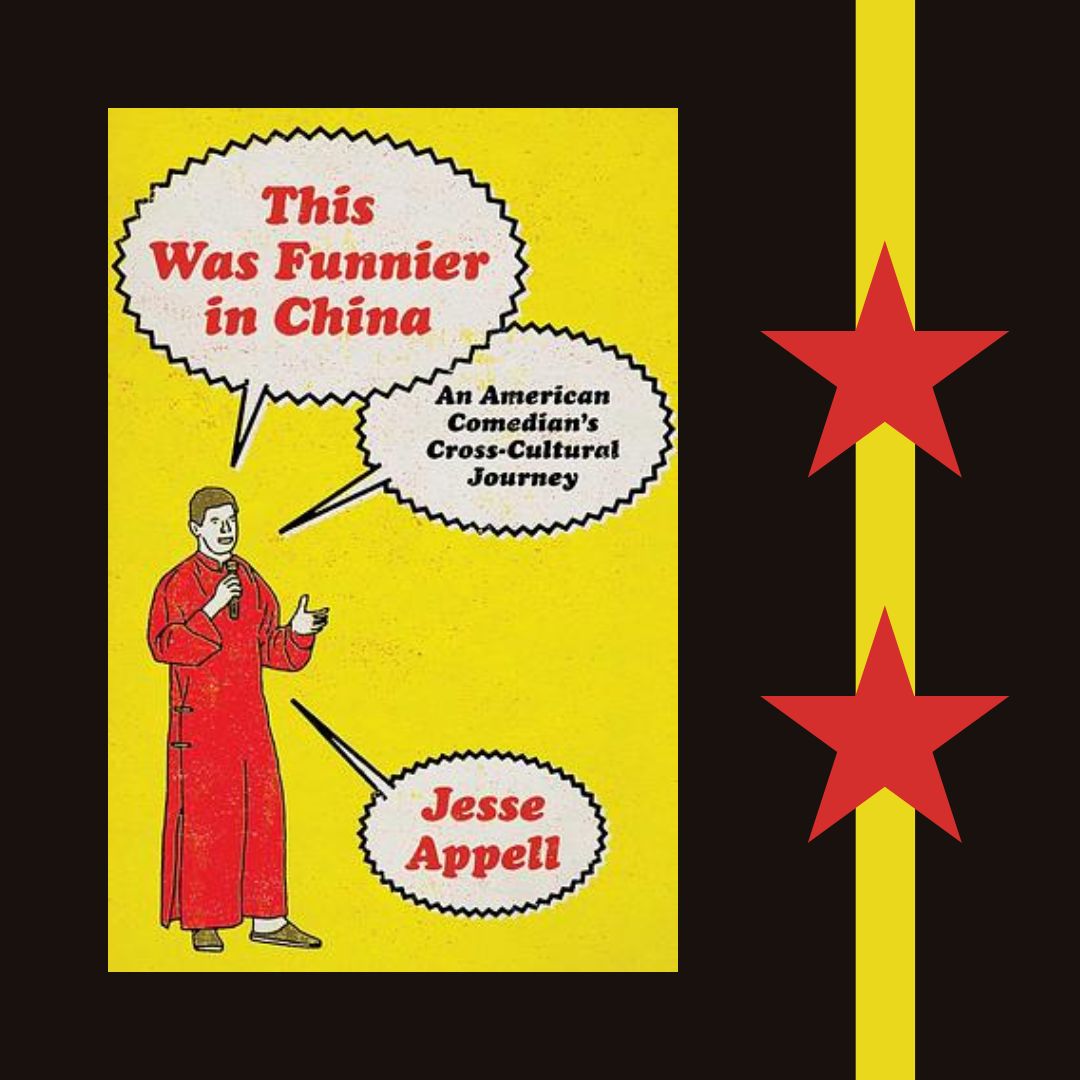

Comedy is hard. It requires timing, the ability to spin stories, and a gift for finding the absurdity in everyday life. Comedy in another language and culture raises the difficulty level exponentially. In This Was Funnier in China, Jesse Appell recounts his journey to becoming a stand-up comedian thousands of miles away from his hometown in Boston. There are some funny moments in this book, but I wish that Appell had spent more effort on the history of Chinese comedy and the cultural differences between America and Chinese comedy.
Appell was already fluent in Mandarin when he applied to legendary xiangsheng performer Master Ding while on a Fulbright scholarship in Beijing. The way he tells things, learning xiangsheng and Chinese comedic conventions might have been harder than learning Mandarin. Xiangsheng requires two performers, a joker and a straight man. The form, which dates back to the nineteenth century, uses scripts that blend wordplay with Chinese history, literature, art, and culture. The joker character is an absolute wildcard, while the straight man often loses their temper over the course of the performance. (Appell doesn’t mention Abbott and Costello but they were immediately who I thought of as Appell described scripts and rehearsals.)
Later, Appell develops his own one-person stand-up routines. He uses what he learned under Master Ding to help him craft jokes and stories that will be funny to Chinese audiences. (The jokes are also pretty funny for English speakers with the subtitles on.) I was very interested in the differences between what Chinese audiences find funny and what American audiences laugh at. Appell is able to make a lot of jokes about regional stereotypes that wouldn’t fly with American audiences. On the other hand, Appell, Master Ding, and other Chinese comedians have to take a lot of care to clear their performances with government censors.
This Was Funnier in China has a very choppy pace. Appell leapfrogs through his life in China, from student to apprentice xiangsheng performer, to solo comedian, to TV writer, with very little to connect the different periods or projects. I’m still not entirely sure why Appell chose to set up a stand-up venue in Beijing. I also wish that Appell had included more anecdotes about his strange adventures in China. His stories about escaping to the countryside during New Year (the constant use of artillery-grade fireworks drive him batty) or the bizarre hotel he stays in while writing for a Chinese TV network in Shanghai are wonderfully funny. I wasn’t sure if Appell was withholding material for his own comedy or if he just didn’t know how to stitch his bits and stories into a longer narrative.
In addition to needing some more slices from Appell’s life, I would’ve liked to see more analysis of Chinese comedy. I disagree with people who think that dissecting jokes kill their humor. Rather, learning more about the layers and references to xiangsheng made the jokes funnier. Years ago, I read Ben Lewis’s Hammer and Tickle, a study of Russian humor that I found fascinating. I think I was hoping for more of what Lewis presented when I picked up This Was Funnier in China from NetGalley.
I received a free copy of this book from the publisher via NetGalley, for review consideration.