
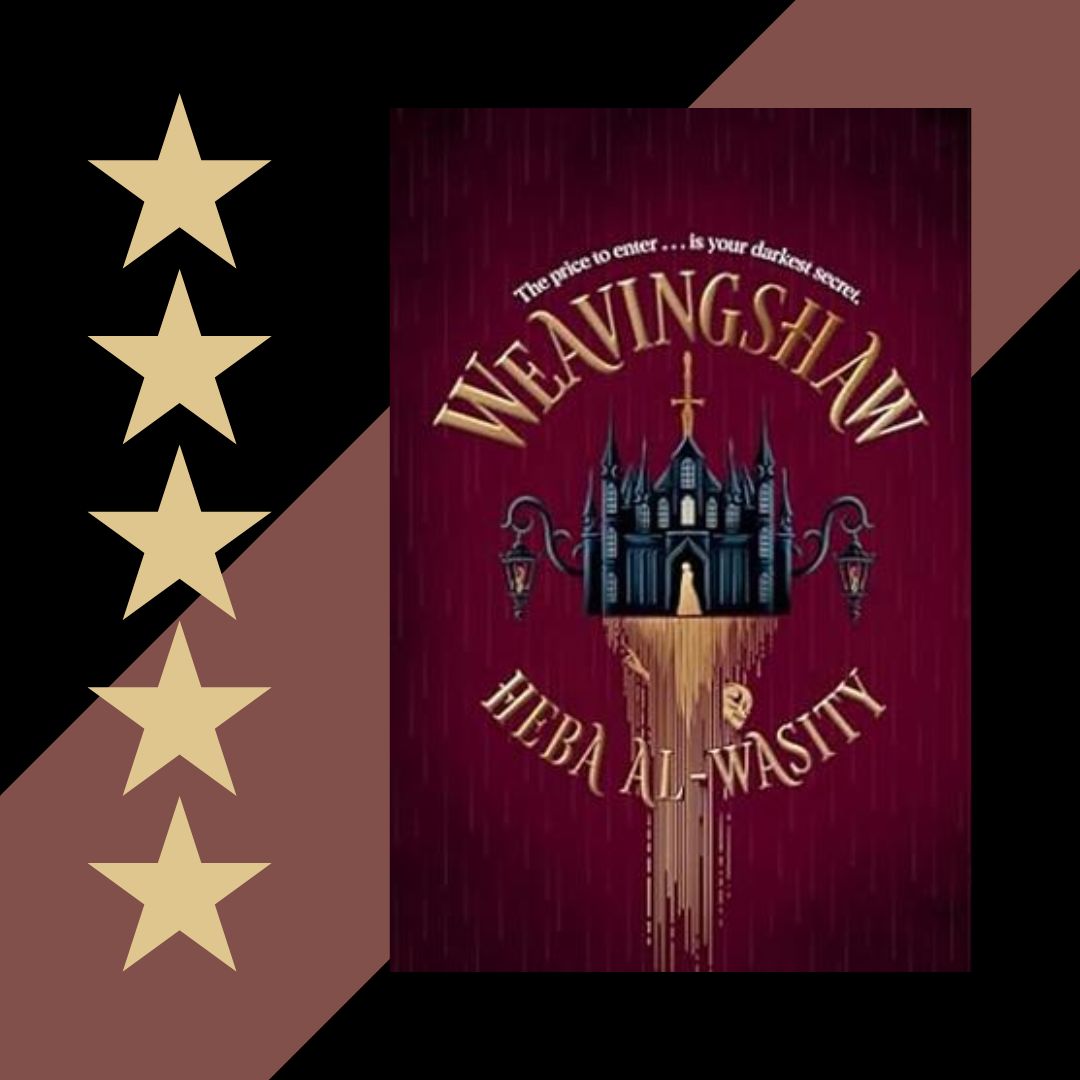

Leena is no stranger to making bad bargains. Being a poor refugee takes away a lot of choices, especially when that poor refugee sees ghosts. It’s hard holding down even a menial job when your employer’s late, probably murdered wife keeps popping up. But there are lengths even Leena won’t go to in Heba Al-Wasity’s engrossing new novel, Weavingshaw, at least until her brother comes down with an illness that can only be cured with medicine she can’t afford. To save her brother’s life, Leena will make a deal with the notorious Saint of Silence.
The Saint of Silence is far from a fool. Once he determines that Leena isn’t lying about her ability to see ghosts, Bram St. Silas metaphorically twists her arm until she agrees to work for him as he gathers the city’s secrets. On top of that, Leena also has to find the ghost of a man who died more than a decade ago. Only then will St. Silas give Leena her liberty. The Saint has a fearsome reputation. People who lie to the saint are later found with their lips mutilated. Others are humiliated when the Saint decides that their secrets aren’t worth the coin. Little wonder, then, that Leena spends her first weeks in his employ scared to death—at least until her anger starts to wake her up to the secrets the Saint himself holds.
Leena is an open book (though she hates this when St. Silas tells her so) compared to St. Silas. After her brother is cured of his illness, Leena’s new mission is to figure out what the hell is going on with the Saint. For someone so concerned at keeping their secrets secret, St. Silas should’ve known better than to offer Leena room and board in his house. Proximity means that Leena can observe and learn from what the Saint does with the information he collects. Why does he seem so concerned with the Black Cloaks, the paramilitary organization that roughly keeps order? Why does he sometimes pay for secrets that he doesn’t record in his ledgers? Why is it, when St. Silas does record something in his ledgers, that the person who spilled their guts to him suddenly ages in minutes? And what is St. Silas’s connection to the mysterious estate of Weavingshaw, a place her mother warned her never to visit?
I love a cocktail of fantasy and mystery. Adding magic or the supernatural puts fresh twists on crimes that would, in detective novels or police procedurals, be solved with forensic evidence and login. When fantasy enters the scene, it gets harder for me to predict what will happen next, because anything could happen next. Readers of this blog will know that I am always hunting for original stories that show me something I’ve never seen before. Weavingshaw absolutely delivers. I was fascinated by the revolutionary subplot and the monstrous cabal behind a lot of the misery in Leena and St. Silas’s world. Al-Wasity doesn’t make anything easy for her protagonists, either, which kept me reading later into the night than I should have. This book is incredible and I can hardly wait for the next installment.