
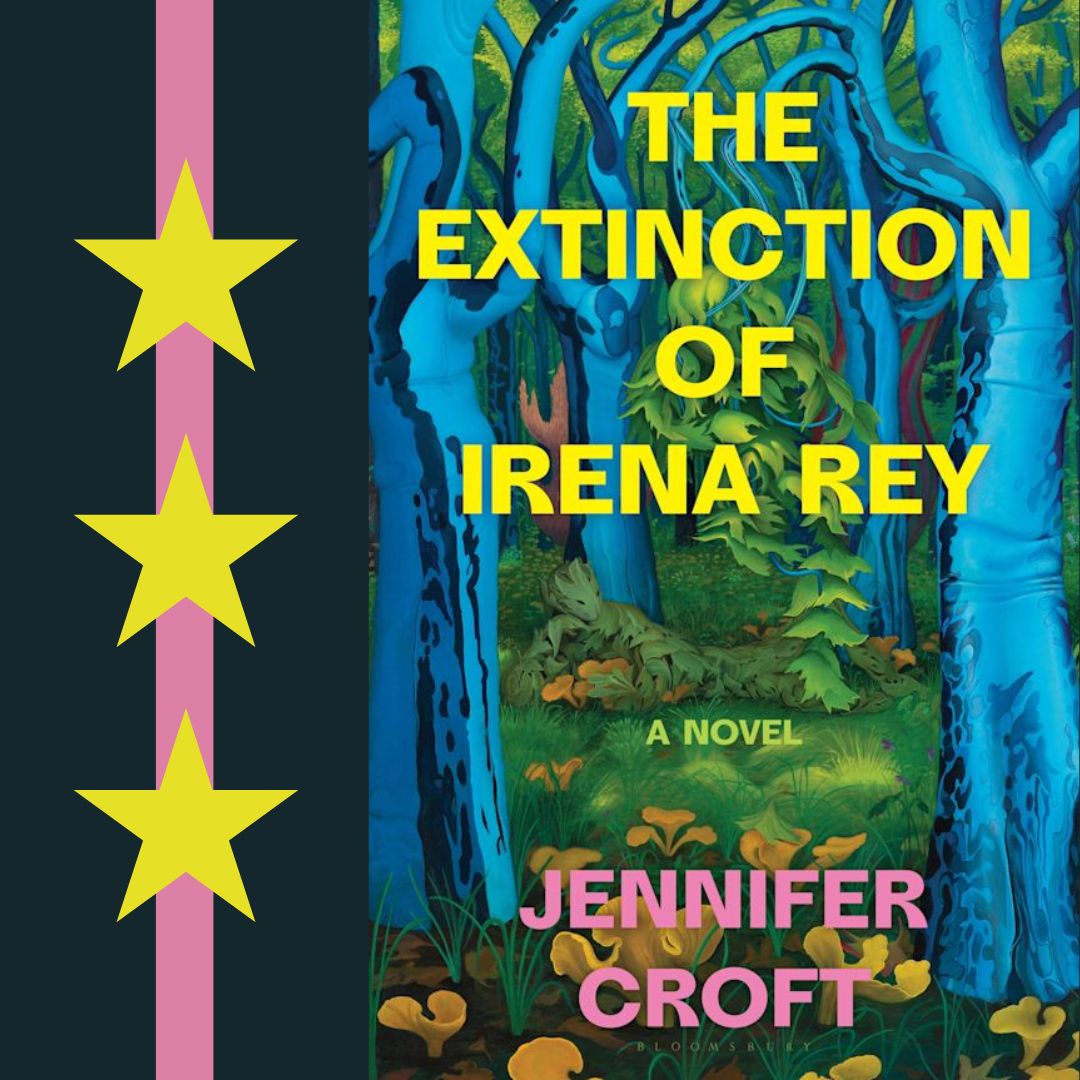

When she finishes a new novel, Polish author Irena Rey, summons her translators from around the world to her home at the edge of the Białowieża forest. The translators must follow strict rules: they only address each other by the name of the language they translate Polish into; they don’t eat meat; they cannot share their work with their editors until it’s finished; they are forbidden to translate other Polish authors. The cult vibes are strong with this group. Jennifer Croft’s layered, sometimes confusing novel, The Extinction of Irena Rey, follows Spanish translator, Emi, during the last summit the group will ever have. We are pulled straight into one of the most dysfunctional groups of characters I’ve ever read, just when everything is going to fall apart.
A translator’s note by Alexis Archer, who turns out to be Irena’s English translator, sets us up for a frame narrative that challenged me to keep everything straight. I had to read this note twice because I kept getting confused about the narrators in the first half of the book. The author of the book Alexis is translating is Emilia Martini, who wrote a book called The Extinction of Irena Rey (which is what we’re reading). Alexis translated Emilia’s book in spite of Emilia’s startlingly vehement animus towards Alexis to get a chance to tell her, Alexis’s, side of the story, which she does through footnotes.
I had a mixed reaction to The Extinction of Irena Rey (Croft’s book). The first two thirds of the novel do a terrific job explaining who Irena, Emilia, Alexis, and a few of the other translators are. Emilia is utterly devoted to Irena, to the point that she is always referred to as Our Author when she’s not named. Irena, like a god, can do no wrong in Emilia’s eyes, even though she is ludicrously demanding of her translators. Every word she writes is perfect, intelligent, worthy of the Nobel Prize for Literature. Anyone with a stronger sense of self would ask a lot more questions about Irena and her rules. But Croft lets this part drag on far too long for my taste. She also litters the text with all kinds of clues that may or may not turn out to be red herrings.
Early in The Extinction of Irena Rey, the great author herself vanishes without a word to her cadre of translators. The author’s husband, Bogdan, also disappears. This has never happened to the translators before and they don’t know what to do without Irena to tell them what to do. Then they receive an email with the subject “Do Not Open” containing Irena’s latest manuscript. The translators struggle with the decision to start their work or wait for Irena to come back. When Irena fails to return, the group opens the manuscript. This first transgression (if it even is one) is followed by many more as order breaks down. Some of the group, like Emilia, want to keep to Irena’s rules. Others, like Alexis, argue that they need to get on with the work. The tension between the two poles of the translators takes a turn for the weird when a park ranger chases them out of the Białowieża forest, an archer takes a shot at the French translator, and strange emails and Instagram posts that might be from Irena start to arrive.
The last third of Croft’s novel makes up for a lot. The plot speeds up as Emilia starts to realize how much Irena has lied about. I don’t want to give any details away because the twist and the pay off are worth a certain amount of wasted time trying to figure out what to pay attention to. I very much appreciated the sense of dread and Lord of the Flies behavior as Emilia and the other translators try to cope in the absence of Irena. These translators either need a lot more adult supervision (ideally from someone other than Irena) or to be split up and sent far away from each other so that they can regain their grip on reality.
I am fascinated by the process and philosophy of translation. That’s what drew me to this book in the first place. Translation is as much an act of creativity and skill as writing is. Translators have to choose their words with as much, or even more, care than authors do. Emilia consistently downplays this, preferring to be as invisible as possible in the work she translates from Polish into Spanish. She is repelled when other translators in their group argue about the importance of their role. Without them, after all, far fewer people would be able to read the great author’s words. When the twist comes near the end of the book, I was delighted to see what Croft did with the concept of translation. I just wish that more time had been devoted to the really interesting ideas about Irena’s great project and the role of translation that are too briefly discussed in that engaging last third of the novel.
