
Trigger warning for gore.

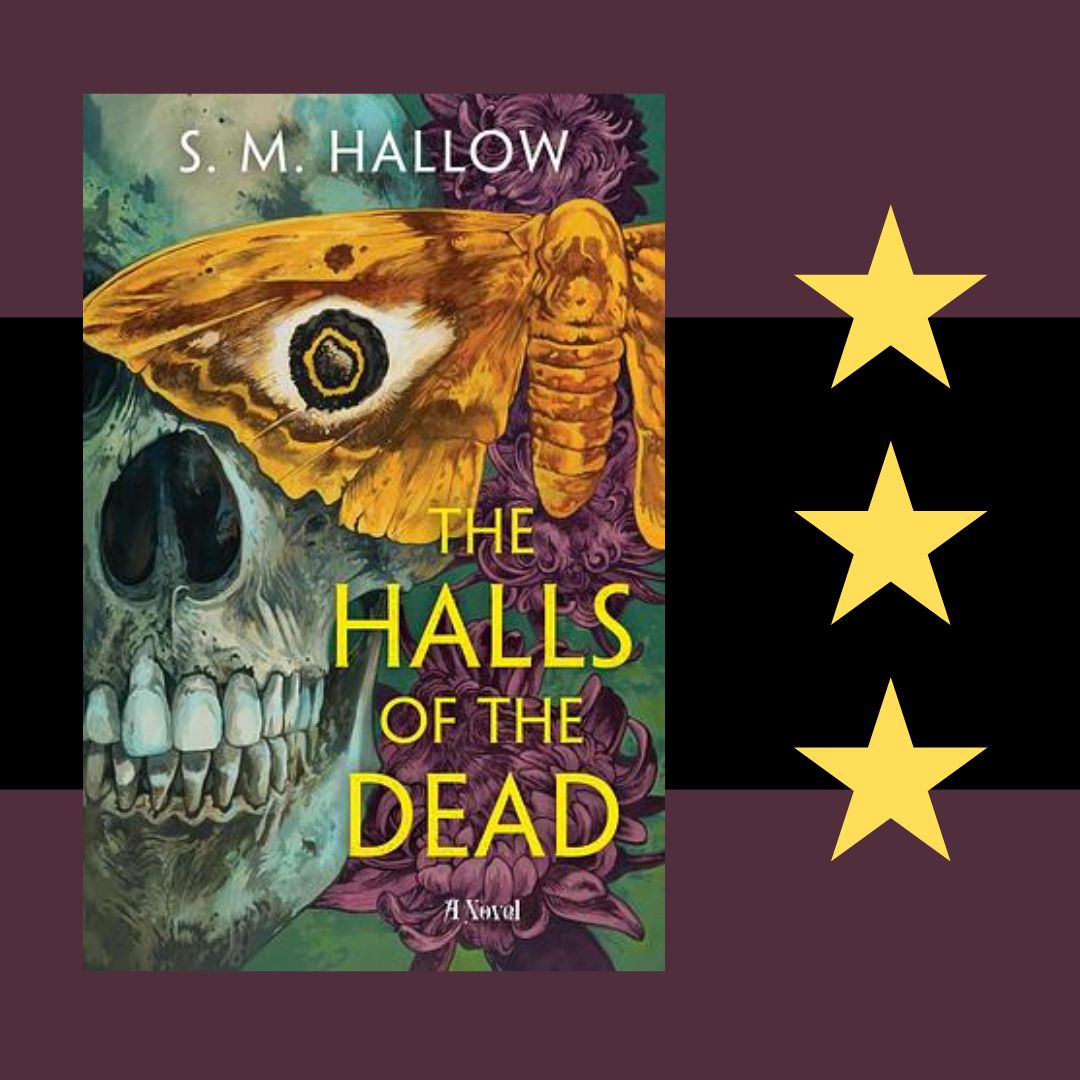
S.M. Hallow puts a spin on necromancy I’ve never seen before in The Halls of the Dead. I’ve always seen necromancers portrayed as villains who raise armies of skeletons or zombies to defeat the good guys. In the world Hallow creates for her trio of protagonists, necromancers have been in a mostly losing struggle against Christians. (I realize this still makes them sound like villains.) To the necromancers in this world, the ability to raise the dead is a divine gift. Lives and knowledge can be resurrected or permanently preserved—but only if the necromancers can avoid being completely wiped out by forces of the church.
Three narrate The Halls of the Dead. Irene is a necromancer with a (literally) damaged soul. We meet her and her husband, St. John, as they dig up the body of Irene’s lover. Agnes, Irene’s lover, becomes a narrator after she is resurrected. St. John is an ever-faithful assistant to Irene and Agnes. He’s not entirely human. Centuries ago, he gave up his mortal life to help keep necromancers and their knowledge safe. As the narrative shifts between these three, we learn about the tragic history of the persecuted necromancers of the past, how Irene lost a part of her soul, and how Agnes came to be executed. We also get long trips to the Halls of the Dead, where the ghosts of the deceased linger. If you haven’t already gotten the impression, there is a lot going on in this book.
In the “present” of the novel, our protagonists face a sinister (but not terribly well developed) enemy in the form of Sir Silas. Silas is determined to wipe out necromancers, even if he has to compromise his values to do so. Because our protagonists quickly become overpowered with magic and physical might (I did enjoy Agnes come into her own as a “monster”), I never doubted that they would defeat Silas. I did raise my eyebrows at how they took Silas, though. I was not expecting our putative heroes to be as ruthless as they are with their enemies, no matter how badly those enemies treated them.
This brings me to a realization I had while reading Irene struggle to fully resurrect Agnes at the beginning of the book. It has never occurred to me to think that resurrection via necromancy was a selfish act, done by a person who cannot deal with the grief of a lost loved one. At least one ghost that Irene talks to resents that Irene attempted to resurrect her after dying in childbirth. Irene has enough power, apparently, that she never has to learn how to let people go. Irene, Agnes, and St. John are protagonists only because they tell their own story. We know what motivates them. I daresay that The Halls of the Dead could be flipped on its head by telling the story from the perspective of Silas, because at least our protagonists commit several murders and other, lesser crimes between them. It wouldn’t be hard to see them as villains if we just got a different point of view.
There are things I liked about The Halls of the Dead (mostly Agnes), but I’m left with mixed feelings. Parts of the story feel lush with description and lore. Other parts, like characterization for anyone beyond the three protagonists, are lacking. I also felt that the plot was rushed in places. The ending is astonishing, and not entirely in a good way. All that said, readers looking for a different spin on necromancy might be interested in picking this book up.
I received a free copy of this book from the publisher via NetGalley, for review consideration.