

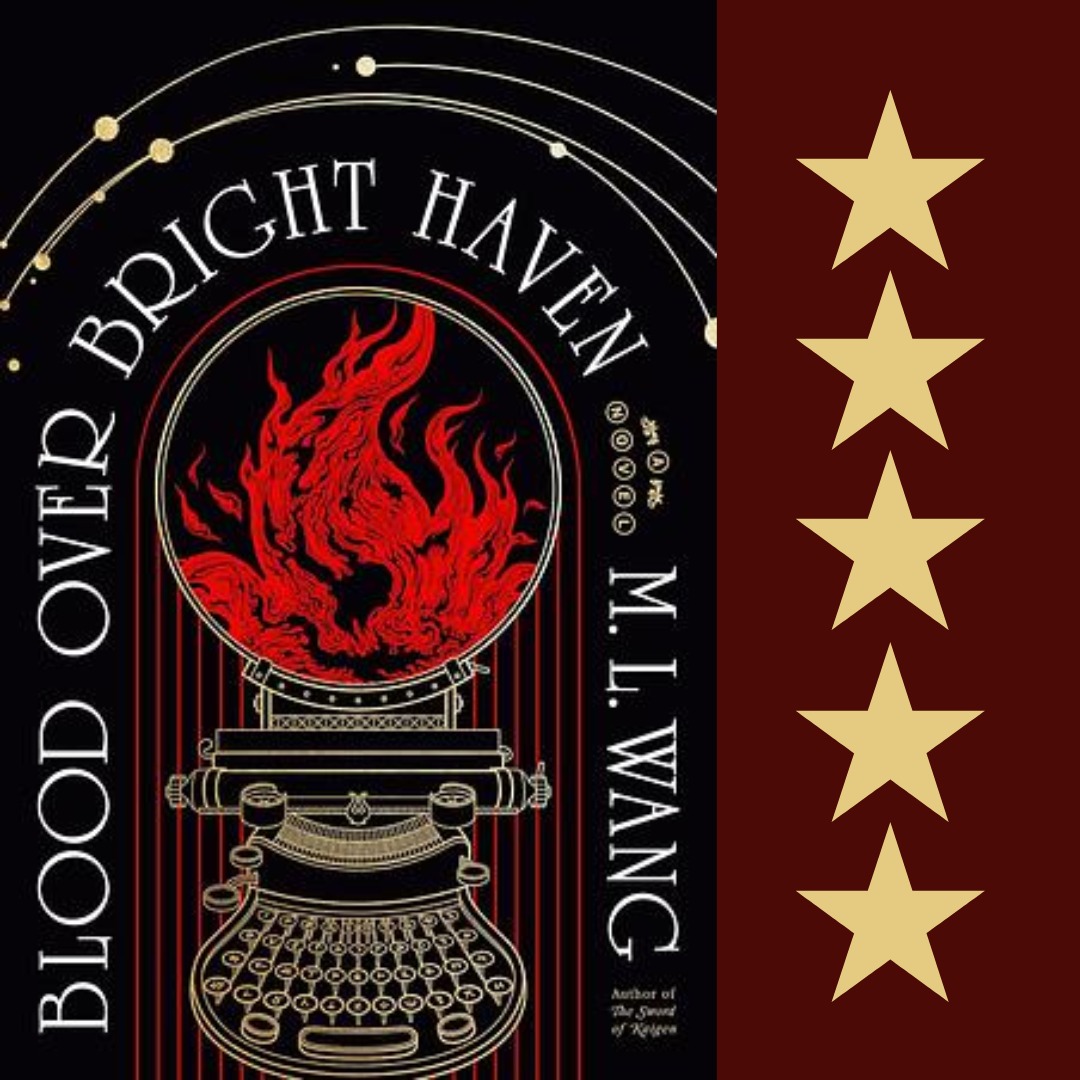
They say that comedy is hard, but I would argue that writing a story with a message without being preachy about it is just as hard. M.L. Wang’s devastating novel, Blood Over Bright Haven, is one of the best stories with a message I’ve ever read. Wang’s characters learn about the cruel power running their world slowly, organically. There are no easy answers and trying to right the Big Wrong has real consequences. Fellow readers, this book absolutely deserves all the hype.
A harrowing prologue provides a stark contrast between the city of Tiran and everything outside of the city’s borders. Outside of Tiran, food is scarce and every living thing is at risk of the Blight. The Blight kills or maims everything it touches and it can strike without warning. We see Thomil’s entire clan, save himself and his niece, killed by the Blight as they run for the safety of the city. Inside Tiran, where the majority of the novel takes place, magic powers lights and transportation. Magic also powers the shield that shelters the entire city and its territory from the Blight. Sciona, our other narrator, doesn’t have to worry about mundane things like food and security the way Thomil does. Instead, her thoughts are consumed by becoming the first woman high mage in Tiranian history.
Sciona and Thomil are thrown together on Sciona’s first day at the High Magistry by one of Sciona’s uncollegial colleagues. No one wants to work as Sciona’s assistant (because she lacks testicles, presumably), so Thomil is assigned to work with her. (Thomil is no mage or scholar. Because he’s not a native of the city, he works as a janitor.) In the end, having an outsider work with her turns out to be a boon. Sciona digs more deeply into the roots of Tiran’s magic as she tries to make a hug breakthrough finding sources for the magic that runs Tiran than any of her predecessors and colleagues, thanks in part to Thomil’s questions. Readers who have read Ursula K. Le Guin’s story, “The Ones Who Walk Away from Omelas,” might figure things out before Sciona does.
When Sciona does learn what powers Tiran’s magic (and after she’s recovered from the emotional upheaval her discovery causes), she refuses to rest while such a great injustice stands. And here’s another thing I very much loved about Blood Over Bright Haven: Wang does not make anything easy for this novel’s protagonists. Just telling the rest of the city the cost of magic isn’t enough to foster change. Sciona also has to learn how invested her superiors are in maintaining the status quo before she can be pushed to even greater acts of rebellion. I didn’t put this book down at all during the last third because I just had to know how it would all turn out.
Blood Over Bright Haven‘s magical system has a lot to say about the costs of our own energy demands on the environment, as well as how much entrenched people in power will fight to stay in power whenever they feel threatened. Wang shows us a city were the city’s rulers have had two centuries not only to accumulate power, but also stop anyone in the city from wondering where the magic comes from. It’s incredibly chilling to watch Sciona discover just how much of her city’s history has been curated to prevent exactly the kinds of experiments she’s running and the questions she has to ask about what Tiran’s mages are doing to the rest of the world.
This book is absolutely incredible.