
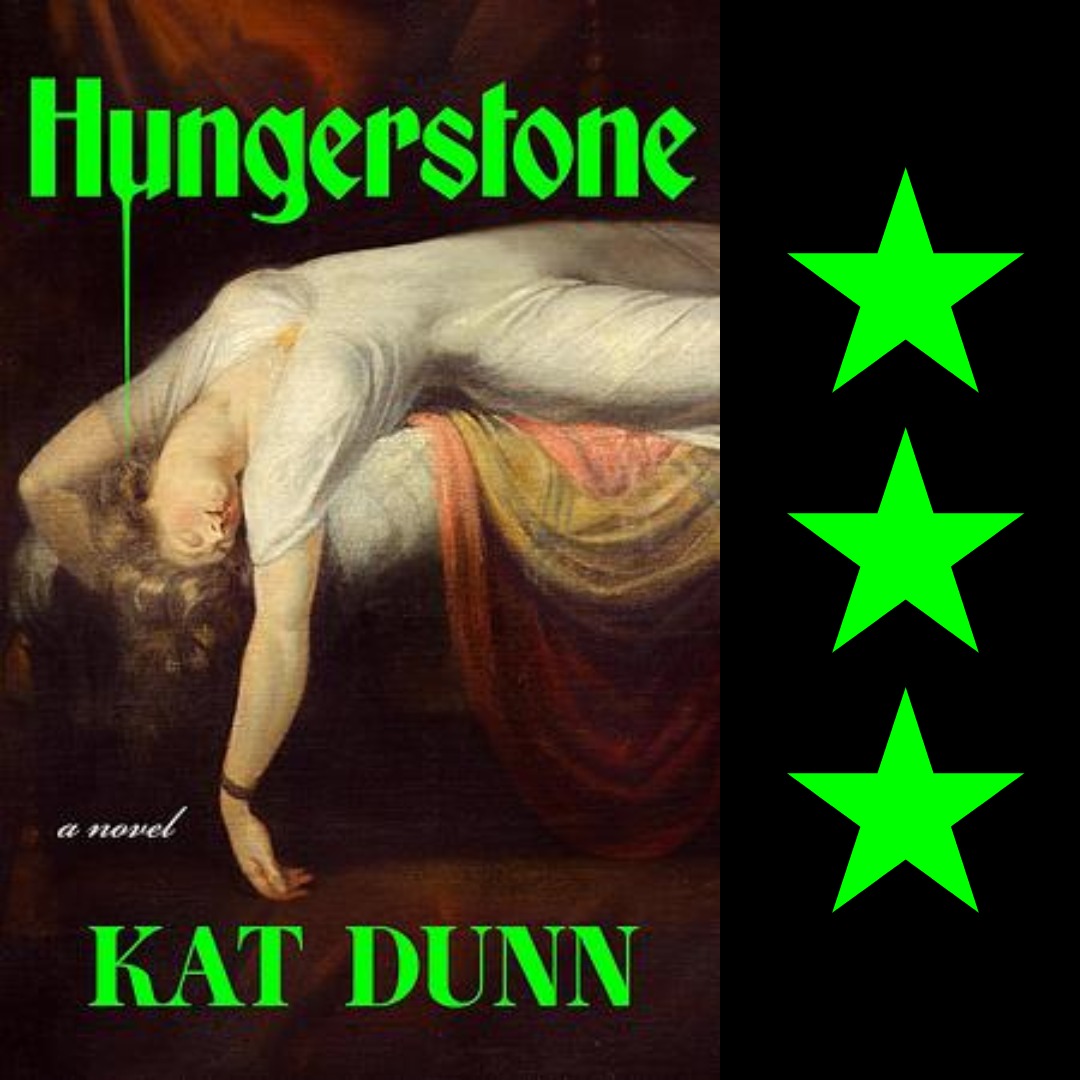

Lenore might be the best example I’ve ever come across of a repressed Victorian. She has conformed to the model of an ideal upper class English wife ever since she met her husband, Henry. She is always perfectly dressed and knows how to behave. She has such control of her facial expressions, to keep stray emotions hidden, that I would never want to play poker with her. Such rigid control is impossible to maintain under pressure. And in Kat Dunn’s Hungerstone, Lenore finally, spectacularly cracks under the strain.
Because we have a ring-side seat to events inside Lenore’s head, we know exactly how lonely and stressed she is. She’s an orphan with no family. She has no friends, either, because no one knows who she really is under her perfectly respectable facade. Her husband only married her for access into the aristocracy, in exchange for monetary support. Henry hasn’t touched Lenore in ages. He’s also fairly brittle, too. We get hints that his Sheffield steel works is in legal and financial trouble. Henry is so determined to move up the social ranks that he has spent money he shouldn’t on a decaying estate near Sheffield. Lenore now has to oversee the restoration of the estate and host a shooting party. There can be no mistakes.

From the moment Lenore and Henry find Carmilla at the scene of a carriage accident on their way to their new estate, savvy readers will know that we’re in a retelling of Joseph Sheridan Le Fanu’s 1872 novel, Carmilla. From the carriage accident to the character’s name to her unsettling bloodthirstiness (literal and figurative) to the late night visits, there’s no doubt that Lenore has landed smack in the middle of a Gothic novel. But where the original Carmilla is focused more on sensation and shocking Victorian morals, Hungerstone is a psychological exploration of what happens when a woman with the energy of a trapped rabbit finally finds the strength to let go of her inhibitions and go after what she wants.
And what Lenore wants is revenge. Being at the estate, away from her usual social duties, means that Lenore isn’t under the constant surveillance of other people’s expectations. Henry is busy at his steel works (or perhaps busy with something else entirely). With Carmilla asking such odd questions of Lenore such as “What do you want?” Lenore starts to wonder if the bargain she struck with Henry when they got engaged is really worth it. The pace of Lenore’s reawakening is slow—frustratingly so if you’ve read enough historical mysteries in which a character starts to display the symptoms of arsenic poisoning. When Lenore finally does decide that she’s had enough, the story becomes electrically entertaining. Unfortunately, the bloody denouement of this book was far too short and abrupt for me after all the build up. I would’ve liked to see at least a bit of an epilogue after Lenore lights out for the continent at the conclusion of Hungerstone.