
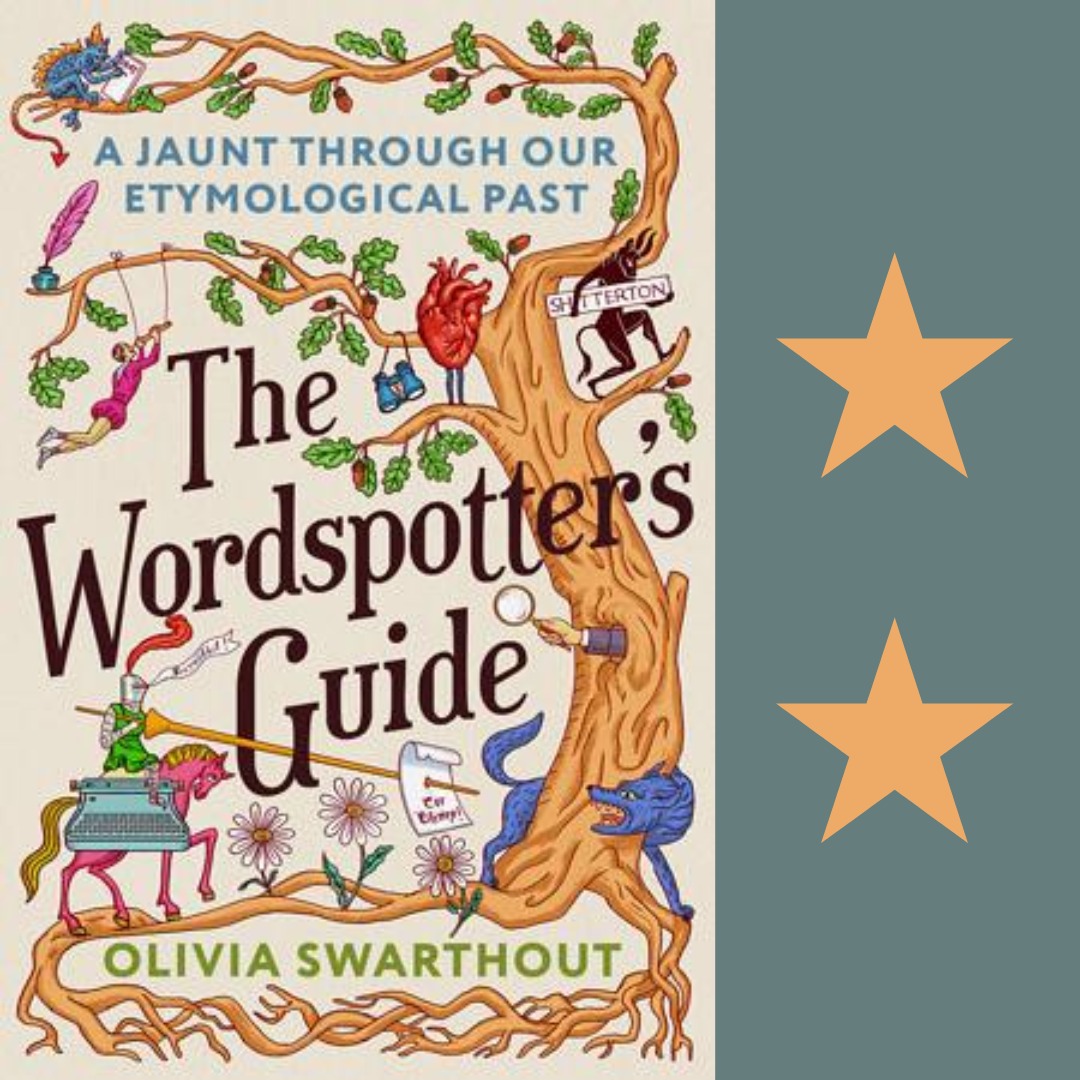

The subtitle of Olivia Swarthout’s The Wordspotter’s Guide: A Jaunt Through Our Etymological Past accurately describes this freewheeling meander through all kinds of categories of English words. Arranged as a walk through the day, we start inside a house and its various rooms before wandering outside into a garden, then the wilderness, and finally the cosmos. A glossary at the end of the book offers very short explanations of etymological and linguistics terms, but Swarthout’s wandering is really about the joy of discovering the history hidden inside every day words.
This book was somewhat frustrating for me, as I wanted to learn more about how etymologists and linguists establish the descent of words. I know a bit about linguistic reconstruction and how linguists have created genealogies for languages. Swarthout includes some of the diagrams showing how related terms diverged from their Indo-European roots, but she doesn’t go into the the methods linguists use to establish those relationships. For example, Grimm’s law (which describes the very regular changes between Proto-Indo-European and Proto-Germanic) and other rules appear no where in this book. Readers who are looking for this kind of information would be better off with a different book.
What Swarthout does do in The Wordspotter’s Guide is remind us of how very metaphorical language is, once you know the roots from which our vocabulary springs. Swarthout shares how words like druid, true, trust, truth, and truce share a root that means tree. She reminds us that our word meander comes from a river in what is now Turkey that has more curves than a pinup model. And she notes just how sticky-fingered English is by giving numerous examples of words that were borrowed (and sometimes re-borrowed) from languages that English speakers encountered as they traveled the globe. I was charmed to learn that the name chameleon (from ancient Greek) means “ground lion” and walrus (from Dutch) means “whale horse.”
No wordspotter’s guide—or etymological guide—can cover everything. It would be too long, for one thing. For another, too much has been lost over the centuries. Dictionaries generally limit themselves to the print version of the language which, at least until the advent of social media, lags far behind what speakers are doing to the lexicon. The earliest versions of Old English are mostly lost due to illiteracy and poor records storage. But thanks to very observant folks like Swarthout, we can perhaps work out a good guess as to the origins of the words we use to describe the world around us and the ideas that pop into our brains. This book is a fun introduction to the possibilities of etymology.
I received a free copy of this book from the publisher via Edelweiss, for review consideration.