
Trigger warning for brief depictions of rape, bestiality, and mass murder.

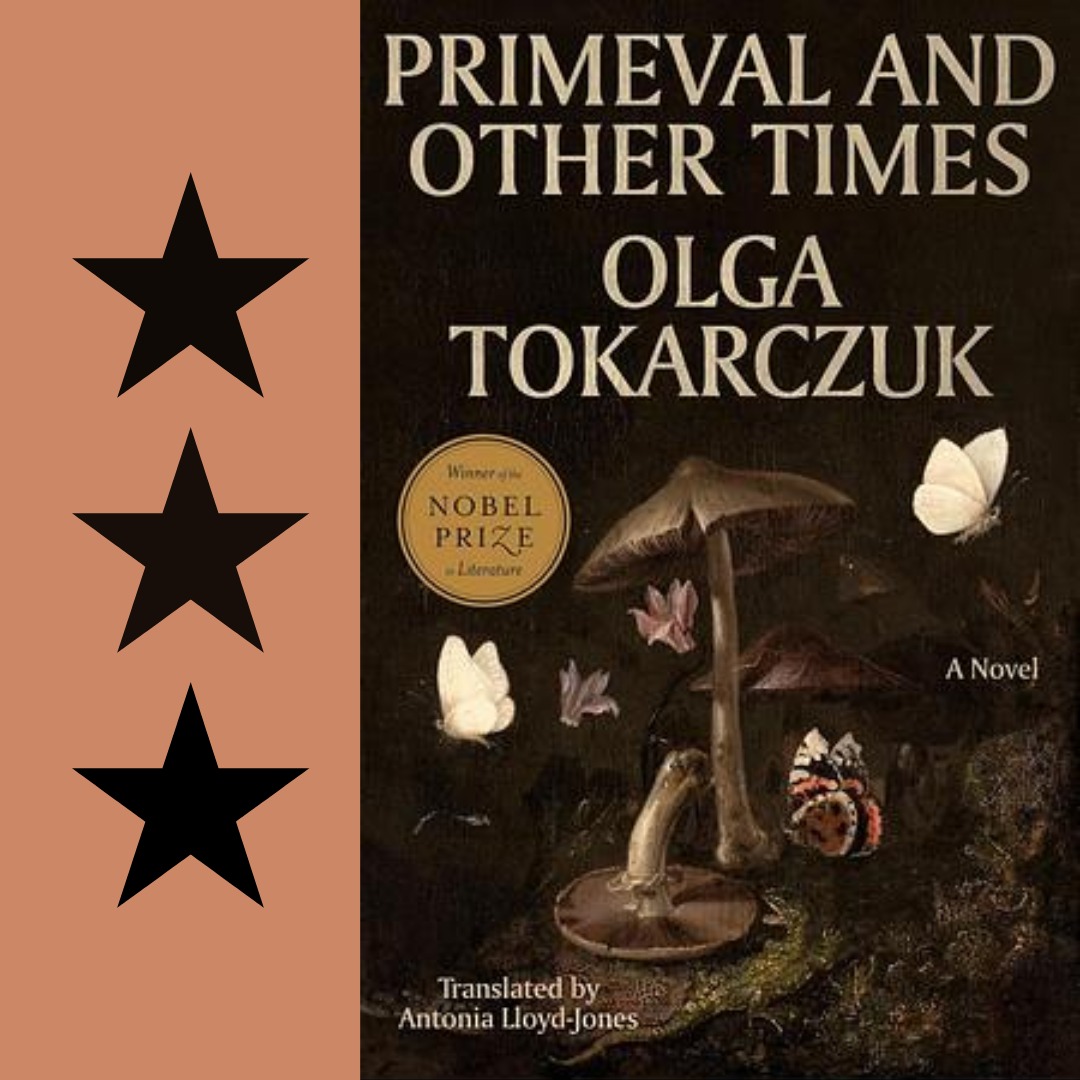
Set near Kielce, Poland, the villagers in Olga Tokarczuk’s novel in stories, Primeval and Other Times, the lives of villagers are disrupted by war, spirits, and the weight of time. The tales span from World War I up through the 1970s (as far as I can tell) and follow characters ranging from a woman who makes her home in the forest to the local gentry. This book gallops along, barely leaving us time to ponder the what ifs and the way that the past is never completely forgotten no matter how much we might might want to. This book is gamely translated by Antonia Lloyd-Jones.
Because this is a novel told in tales, it demands that the reader work to pay attention to a lot of details and then build meaning out of them. Also because this is a novel told in tales, I felt like there were a lot of ideas that weren’t fully explored as the various characters are battered by history. For example, I very much wanted to know more about Cornspike’s life in a forest that seems to have completely ignored modernity. I also wanted to learn more about the curious game played by Squire Popielski, a game that seems like an incarnation of god playing dice with the universe. What are we to think of these more supernatural plotlines when Genowefa’s family struggles to stay alive when threatened by the historical threats of Germans, Russians, and Communist totalitarianism?
The emphasis on time and Primeval’s seeming isolation from the cities it neighbors made the town feel like a crossroads between the ancient and the modern, the mystical and the mundane. It also feels like a place of chaos and there’s no throughline to help us connect all of the plotlines. Which is fitting, given that we ourselves have no idea where history is going to take us. On the other hand, it leaves us wondering what to make of everything. Are these characters living in different realities from each other that just happen to intersect occasionally? Does time weigh more lightly or heavily in different places? Is there a conflict between the magical and the mundane? There are no answers here and it’s hard to say if the old adage of “the only way out is through” even applies when no one in Primeval knows what’s coming over the hills next.
Readers who enjoy narratives that resist easy analysis or who prefer to see history un-teleologically might enjoy this one.
I received a free copy of this book from the publishers via Edelweiss and Netgalley for review consideration.